Thursday, October 29, 2009

The Annapolis Convention & Federalist Papers


The Annapolis Convention convened in order for the representatives of the states to vote on whether to change the Constitution, pursuant to Article XIII.  The Union was a disaster and many were unhappy about it.  The states recognized that it needed to change, and if the Federalist Papers are any indication, they were leaning towards our current Constitution, but some opposed it.

The purpose of the Federalist papers was to stress the importance of adopting the Constitution.  In “The Federalist Papers: No.1,” Alexander Hamilton notes that

The subject speaks its own importance; comprehending in its consequences nothing less than the existence of the UNION, the safety and welfare of the parts of which it is composed, the fate of an empire in many respects the most interesting in the world.

The world was watching to see what would become of the young country.  The Articles of Confederation wasn’t working, as we saw from Shay’s Rebellion, but what other course of action did they have?  It wasn’t just the country’s reputation at stake, it was also the liberty of all those who belonged within its borders.  Why would the states need to be convinced to adopt the Constitution?  Hamilton writes of a proposed alternative, in which the US would be divided into separate confederacies.  It was in his opinion that adopting the Constitution would benefit the safety and welfare of the country.  John Jay concurred with Hamilton in his Federalist Papers.  He also gave reasoning behind the desire to adopt a Constitution with a stronger central government:

It has until lately been a received and uncontradicted opinion that the prosperity of the people of America depended on their continuing firmly united, and the wishes, prayers, and efforts of our best and wisest citizens have been constantly directed to that object.

He believed that the success of America depended on the unity of the people.  After the Revolutionary War, the people came together and acknowledged that they needed to form a government quickly to establish themselves as a country.  They didn’t even take the time to get their lives in order before the Continental Congress drafted the Articles of Confederation.  If the US were to be divided into separate confederacies or sovereign entities, it would be weaker.  And who would stop foreign powers from invading to take over?  Jay noted that the US was party to several treaties, but if one of the foreign nations decided to break the treaty, separate confederacies wouldn’t be able to fend them off.  Jay stressed the safety of the people in general.  He also explained that if the Constitution were ratified, government would act in the best interests of its citizens:

Because when once an efficient national government is established, the best men in the country will not only consent to serve, but also will generally be appointed to manage it; for, although town or country, or other contracted influence, may place men in State assemblies, or senates, or courts of justice, or executive departments, yet more general and extensive reputation for talents and other qualifications will be necessary to recommend men to offices under the national government,--especially as it will have the widest field for choice, and never experience that want of proper persons which is not uncommon in some of the States. Hence, it will result that the administration, the political counsels, and the judicial decisions of the national government will be more wise, systematical, and judicious than those of individual States, and consequently more satisfactory with respect to other nations, as well as more SAFE with respect to us.

Those in office would act to keep the citizens safe from foreign attacks while acting in their best interests.  Our current government was designed to be systematic, instead of the unwieldy giant it appears to be today.  Hamilton, Jay, and Madison stressed safety in the federalist papers, but they were not seeking a “Nanny state” in which the government tells you how to run your life.  They intended the government to run interference with foreign powers.  Think about it: do you really need the government to tell you not to text and drive?  Do you really need the government to tell you how to spend your money?  It’s none of the government’s business if I decided to buy a used car or a new car.  The government shouldn’t protect you from yourself because you don’t want to make a decision, the government should protect you from those seeking to invade us.  In “The Federalist Papers: No. 4,” Jay worried how the US would be able to defend itself without a strong central government.  He noted that at that time, the smallest slight could incite a nation to war.  The US shared fishing areas with Great Britain and France, and it engaged in commerce.  He looked to history to see whether separate sovereignties would be sufficient to protect nation:

Leave America divided into thirteen or, if you please, into three or four independent governments--what armies could they raise and pay--what fleets could they ever hope to have? If one was attacked, would the others fly to its succor, and spend their blood and money in its defense? Would there be no danger of their being flattered into neutrality by its specious promises, or seduced by a too great fondness for peace to decline hazarding their tranquillity and present safety for the sake of neighbors, of whom perhaps they have been jealous, and whose importance they are content to see diminished? Although such conduct would not be wise, it would, nevertheless, be natural. The history of the states of Greece, and of other countries, abounds with such instances, and it is not improbable that what has so often happened would, under similar circumstances, happen again.

He concludes that foreign powers would be less likely to engage in war if the US had a strong efficient government that would be in charge of military forces.
Madison takes a domestic view on the advantages of ratifying the Constitution: it would prevent factions from inflicting their own desires on your life.  Think about it, do you want Scientologists telling you how to live?  I know I don’t.  I don’t even understand their beliefs.  Madison explains that there are 2 ways undermine factions: (1) controlling their causes and (2) controlling their effects.  The only way to control their causes would be to take away individual liberty, which he was strongly against.  As long as there is individual liberty, there will be differences of opinions and differing interests:

But the most common and durable source of factions has been the various and unequal distribution of property. […] The regulation of these various and interfering interests forms the principal task of modern legislation, and involves the spirit of party and faction in the necessary and ordinary operations of the government.

He noted that the role of government would be a moderator between conflicting interests, and that representatives would be able to make sound decisions for the public good.  The representatives would, in essence, control the effects of conflicting factions.

How is our current government doing on that?  Do you feel that your Congressmen and Senators are making wise decisions for the public good?  To me, Congress is beginning to look like a 3-ring circus.  They actually created a health insurance reform bill that is longer than War and Peace, full of legalese, and they expect everyone to read it in a week.  Is it possible?  Ummm, I have a feeling that a lot of representatives will be voting on it without reading it.  How are they going to be able to decide whether voting for or against it would be best for their constituents?  I’d rather have them take longer to read the legislation than vote on it without fully realizing the repercussions.  I kinda feel like reading it just to see if they’re trying to sneak anything heinous by the public, but that’s my Congressman’s job.  I hope he does it.


Tuesday, October 27, 2009

Rant--Is it time for a revolution?


I was going to go into the Annapolis convention, but I decided to rant a little about current events.

We have an oppressive national debt and we’re in the midst of a recession.  Everyone knows that.  Unemployment is high and people are struggling to meet their obligations.  The government has to plan on how to pay off the national debt, the dollar is declining in the world market, and on top of that, it insists on enacting legislation  that would, in all likelihood, lead to more debt.  Since when is spending a good way to get out of debt?  The stimulus package was pushed as urgent legislation.  So far, unemployment has increased, and the only ones who have benefited are those who got us into this mess in the first place.  Now the government has its hand in the financial sector, GM, and it’s attempting to dabble in heath insurance. The government already manages Medicare and Medicaid.  Look how those have turned out.  Do you really think they could handle another insurance program?  I think it would be best if they improved the programs they already have before trying to take on more. 


People who oppose the legislation in Congress have tried phoning the representatives and senators, who were ELECTED into office, only to be hung up on and ignored.  Those who seek to organize a peaceable protest are called “lunatics,” “racists,” and “Nazis.”  It seems as if the government has lost touch with the people who put it in power.  What other peaceable means of rebellion are available to us?   As Americans, we have the right to vote.  We vote the Representatives and Senators into office.  What’s stopping us from voting them out in the next election?  If you don’t like what your representative is doing in office, vote him out.  Of course, nowadays, the parties are similar, except on a couple of issues like gay marriage and abortion.  In the 2008 election, America led a peaceable rebellion in protest of President Bush’s policies.  We elected a man who promised hope and change.  Where is it?  He’s more interested in pushing his own agenda than in rebuilding this country before it’s irreparable. 


If you’re unsatisfied with the current state of things, educate yourself on the issues.  Do you think the government should stimulate competition in the health industry?  Do you think that environmental legislation takes precedence over economic recovery?  Do you think we need another stimulus?  How can we recover all the lost jobs and get America back on track?  Research those running for office.  Factcheck.org is a great place to start.  Sure, researching the issues is time consuming, but with networks making stupid decisions and cancelling excellent programs (I‘m still bitter about the cancellation of Arrested Development), it’s not much of a sacrifice. It’s time to usher in a government that we can trust to listen to what we want. 


Remember, voting is a peaceful revolution.  Is it time for a revolution?

Sunday, October 25, 2009

Treaty of Paris

Where did the war debt come from? I think we need to look to the Treaty of Paris for an explanation.


Once you get past the flowery language and religious references, the treaty was between Great Britain, France, Ireland (what did Ireland have to do with anything?), and the arch-treasurer of the Holy Roman Empire. Peace between the US and Great Britain was conditional upon peace between Great Britain and France. John Adams, Benjamin Franklin, and John Jay were representing the US, with David Hartley, Esq., representing Great Britain.
In the treaty, King George recognizes the states to be sovereign and independent and relinquishes all claims to them. The boundaries are defined to prevent any conflict over them. It allows for fishing rights on banks where both countries are known to fish. The treaty provides that creditors will recover all bona fide debts contracted.

Article 5 of the treaty stipulates that Congress will recommend that the Loyalists recover their property, allowing them to remain in the US for a year for that purpose. Congress would recommend the states’ compliance, and those who bought the Loyalists’ property would be refunded the full value.

Article 6 provides that no one would be prosecuted for participating in the war, and any one who was prosecuted before the treaty would be set free.

Article 7 outlines King George’s obligations. In addition to the peace being “firm and perpetual”, all prisoners on both sides were to be set free. King George was to withdraw his army and navy without destroying or taking any property (including slaves), while leaving any American artillery in the fortifications. The crown was also to return all archives, records, deeds, and papers to their rightful owners.

Great Britain and the US agreed to free and open navigation of the Mississippi River for their citizens, and that any territories conquered after the war but before the treaty to be returned. This treaty was to be carried out within 6 months of its signing in Paris.

George swallowed his pride and accepted a treaty, but the US was screwed. Not only did it have to return property to the Loyalists, which was probably expensive, but it also had to pay off war debts. Didn’t it borrow money from the French? That’s probably why the French were party to the Treaty, and why the Articles of the Confederation provided for the common treasury to pay off all debts accrued. The debts of the US led to a depreciation of the currency, inciting people like Shay to revolt. Revolution and rebellion is the American way, but it doesn’t have to be bloody or forceful. The anonymous author of the editorial called for a peaceful and dispassionate resolution because, in his opinion, it was the best way to come to an agreement. That’s probably how we got to the Annapolis Convention, where our Constitution was conceived.

Before the Annapolis Convention

The Annapolis Convention is where the greats of old negotiated our current constitution.  To figure out why they decided they needed to change their system of government, let’s take a look at some events leading up to it.
Shay’s Rebellion

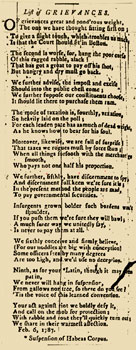
Around 1787, the people of Massachusetts got tired of their current system of government.  What did they have to complain about?  The court was as far away as Boston (I guess they lived out in the country, and nobody had a car), they paid high taxes that didn’t benefit them, the people were starving, and they felt officials were paid too much. 


In an editorial to the government, an anonymous citizen noted:
so the people at large, when they view their present constitution as inadequate to the ends of civil government, have an undoubted power according to the declaration of the bill of rights, to alter or set aside the same, when the period comes, which they, the people, have fixed for that purpose ("To the Public")
No one was satisfied with the current conditions, and by right, they could set aside the current constitution.  The author of the editorial noted their grievances, but cautioned that they should revolt by peaceable means. 

The people wanted to set aside the court of common pleas because it was expensive.  The author explained that the corruption of people that made it expensive, and if they wanted to change the courts, they’d have to change the state’s laws, too, because they were tied together.  The author expressed the fear that if justice courts were set up, it would give magistrates more power, and people would bring frivolous suits to court, clogging up the system, and attorneys
would become more influential and would increase in numbers.

The people wanted a standard currency.  Anonymous explains that the people called for paper money issued by the government because their state’s paper money had lost value because of high internal debt and counterfeiting.

The people were also upset because the government was relatively expensive to run.  The author defended the government’s expenses, explaining that it was true that running the government was expensive, but only a small portion of taxes went towards running the government, the rest went to war debts.

This letter to the public arose at the rise of Shay’s rebellion.  Imagine a bunch of farmer gathering pitchforks and guns to fight against unjust conditions.  The elite and non-elite alike agreed that there was something wrong with governance of the country, but disagreed on how to handle it.  The elite thought a peaceable rebellion was in order; most likely, they advocated writing anonymous letters in the newspaper expressing their discontent.  The non-elite were incited to action after getting fed up, and used whatever tools that were available to them.

Thursday, October 22, 2009

The Articles of Confederation--Part II


Articles II-VI specified the states’ obligations in order to make the new government succeed.  Remember Article VI required them to maintain militias?  Well Article VII gave Congress the power to appoint who would lead those militias in times of war.  Congress charged itself with maintaining a common treasury to pay for war costs and all other expenses allowed by Congress.  Each state had to contribute proportionately depending on the value of the land within their borders.  The states were responsible for collecting taxes in order to contribute to the common treasury.  Compared to our current system, the Articles of Confederation made the government very weak.  The government couldn’t maintain an army but could only appoint officers and it couldn’t even levy taxes.

Only Congress could declare war, receive and send ambassadors, and create alliances with foreign nations.  This was probably to prevent alliances that could undermine their newly found freedom.  They didn’t want Georgie-boy sneaking back in to subjugate them again.  Congress was responsible for deciding legal matters and appointing courts; however, no member of Congress could be a judge.  Congress was to be the last resort on appeal concerning disputes between states and matters concerning land grants.  Article IX sets out a procedure in which one state has to petition Congress to hear the matter.  This article is very specific in how Congress would appoint a judge to hear the matter and what happens if neither party shows.  Some of current rules of civil procedure (note: stuff lawyers have to know, otherwise their case could very easily get booted out of court) seem to derive from this article, including how the court could decide the case if neither party decided to show up.  Only the US government could decide the value of money and metals, seeing as the states could create their own currency (they weren’t told they couldn’t!).  The government was also responsible for regulating trade, dealing with Native Americans, creating and regulating post offices, and appointing officers to the “military” and navy.  


When Congress wasn’t in session, it could appoint a Committee of the States to handle matters that it would normally decide.  Article IX gives Congress the power to appoint committees to manage general affairs, and to appoint one of their members to head the committee, but they could only run it for 1 year every 3 years.  The Committee was responsible for verifying that the states maintained its quota for the militia.  The Article specifically states:

to make requisitions from each State for its quota, in proportion to the number of white inhabitants in such State (Articles of Confederation)

Assuming that the white inhabitants would be the ones fighting in the militias, it only makes sense that they were the only ones to count as populating the states.  But, I thought blacks were counted as ¾ of a person, or something like that.  It must’ve been under the Constitution.  I should probably look into that.

Back to the Articles…For Congress to come to a resolution 9 out of 13 states had to agree.  The Articles mandate that Congress keeps track of its proceedings, except on matters requiring secrecy, and that it record each delegate’s vote.  Any delegate could request a transcript of the proceedings.
Article XI provides that Canada could be admitted into the Union.  Why Canada?  Canada’s a former British colony, too.  I guess Congress wanted Canada to have its back, in case George decided to retaliate before they could ally with the foreign nations sharing the continent.  I wonder, if Canada had consented to being part of the United States, would the US have been able to help them fight for their independence?  The US was saddled with crippling debt and they were just concerned with establishing themselves as sovereign before any other country could claim them as a territory. 

Speaking of debt, Article XII states that any debt entered into by Congress is considered a debt against the US.  That’s were the treasury comes in.  All states contribute to paying the debt, and they are to trust Congress to make the right decisions when it comes to entering debts and managing the treasury.

Article XIII specifically states that each state was subject to Congress (as if it needed reiteration).  The US could only dissolve if Congress agreed.  The Articles of Confederation could only be changed or scrapped altogether if Congress agreed.  Thank goodness for that clause…otherwise we’d never have our Constitution. 

The Articles of Confederation were very thorough in setting out the obligations of the states and Congress.  Congress was afraid that the states would get too powerful, but it was also cautious of a strong central government.  Now I want to know how this failed, because otherwise the Constitution would have never been created.  I guess I’ll actually have to do some research now.


Wednesday, October 21, 2009

The Articles of Confederation--Part I

After kicking England to the curb, the colonies decided to flex their hard won freedom.  The colonies immediately scrambled to set up independent state governments.  The Articles of Confederation was a way to bind them together without stepping on their toes.


The first thing Congress set out to do was to name their new country.  Like a kid creating a super cool name for his clubhouse, Congress needed something that would show the rest of the world that it meant business.  They chose the name “The United States of America.”  With that decided, it then had to figure out what powers resided in the US government, and what powers rested with the states.  Each state is sovereign, but subject to the US, and whatever power wasn’t delegated to the US remains with the states.  So the states wouldn’t get too cocky, Congress then specified which powers were definitely delegated to the States and the US. 

Congress wanted the states and their inhabitants to get along, so the Articles provide that the inhabitants of any state can freely travel between states, and are treated as the residents of whichever state in which they happen to be.  Criminals were denied this courtesy, and the Articles even provide for extradition of those criminals, relying on the judgment of the courts of individual states and giving them “full faith and credit.”

Every year, State legislatures were expected to appoint delegates to the US Congress, which met on the first Monday in November every year.  The states had to appoint 2-7 delegates, and the delegates’ terms could not be longer than 3 years; nor could the delegates hold a salaried office while serving as a delegate.  Each state was responsible for maintaining their delegates.  When it came determining questions in the assembled Congress, each state had 1 vote. 

In Article V, we see the first instance of “freedom of speech:”

Freedom of speech and debate in Congress shall not be impeached or questioned in any court or place out of Congress, and the members of Congress shall be protected in their persons from arrests or imprisonments, during the time of their going to and from, and attendence [sic] on Congress, except for treason, felony, or breach of the peace. The Articles of Confederation
Delegates were granted certain immunities when they were carrying out their official duties.  However, treason, felonies, and breaches of peace were not tolerated.  Delegates were permitted to speak freely and debate in Congress, something Congress now takes for granted.  Did they forget about having the right to remain silent?

Article VI defines the states’ powers.  The states were considered sovereign and independent, but they were not sovereign nations, and as such, were not permitted to ally or enter into treaties with foreign nations or send ambassadors.  The states also could not create alliances amongst themselves.  They were also prevented from impeding US relations with foreign nations.  The states were responsible for maintaining their militias because the US didn’t maintain an army in times  of peace (in Article IX, the US reserved the right to call upon these militias as their standing army and use  whatever resources set aside for them by the states).  The states had permission to defend themselves against aggressors, but could not engage in war (this included pirate attacks--and real pirates were not Johnny Depp in eyeliner).  Congress sought to create alliances with established nations to be able to defend against British retaliation and didn’t want the states interfering.  The Articles clearly mention entering into treaties with France and Spain.  Why? Because they had territory of the majority of the Continent. 

It’s clear the Articles of Confederation attempted to create a decentralized government.  The states were responsible for being friendly with each other and sending delegates to Congress.  They were also charged with helping defend the nation by maintaining militias.  Only the US could engage in foreign affairs, which put the states in their places.  There was a hierarchy emerging.  The states each had their own governments, and their own hierarchies, subject to Congress and the US government.  One thing was certain: they definitely did not want another King George bossing them around.

Tuesday, October 20, 2009

The Declaration of Independence

By 1776, there were 13 colonies, each having independent authority to operate through a charter from the monarchy.  In the 1760s, Britain changed its colonial policy, and began asserting its authority over the colonies. It levied taxes to raise revenues for its wars and aggressively enforced trade laws.  Because the Crown became more demanding, the colonies decided it was time to cut ties with it.


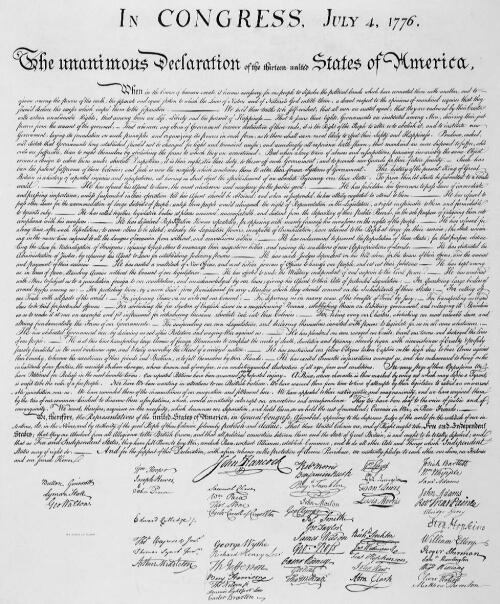
To our country, the Declaration of Independence is the most thorough and important break up letter ever written.  Why a break up letter?  The Declaration of Independence lists the feelings of the colonialists, and then lists the Crown’s shortcomings…essentially emasculating it.  And before you say, “That’s not what happened,” let’s go through the reasons that the Congress decided it was necessary to institute its own government.


First, the Congress declares:

We hold these truths to be self-evident, that all men are created equal, that they are endowed by their Creator with certain unalienable Rights, that among these are Life, Liberty and the pursuit of Happiness. […] But when a long train of abuses and usurpations, pursuing invariably the same Object evinces a design to reduce them under absolute Despotism, it is their right, it is their duty, to throw off such Government, and to provide new Guards for their future security. The Declaration of Independence

The colonies felt smothered by the Crown and that it was within their right to break it off, but not before giving a list of the Crown’s inadequacies.  The king wouldn’t pass laws, nor would he allow the colonies to pass laws concerning pressing matters.  He dissolved legislatures without planning a way for them to be reformed, essentially leaving colonies without government. He allowed his armies to take over the colonies during times of peace and war, and had no manner of controlling his armies.  Congress accused the Crown of standing in the way of its happiness.  The Congress broke it off after attempting to work out the differences, and the Crown refused to compromise.  Not only did it refuse to compromises, but also it added insult to injury. 

After the war that sent the ex in to a slow decline of self-pity and a desire of revenge, Congress enacted the Articles of Confederation.


Congress sought a government similar to that of the charters, but allowed for none of the abuses that they suffered with the Crown.  It wanted a government that would protect them from foreign powers that saw them as fresh meat and the Native Americans that were furious at them for usurping their land.  It also wanted a government that would allow the states their autonomy, as they had under the charters.  It wanted a government that would act when it was necessary, but otherwise butt out of their affairs.  It obviously didn’t obtain that with the Articles of Confederation, but why?  Is it because Congress knew what it didn’t want, but had no idea what it wanted?  Is it because it relied on the models of other governments to show them the way?  Or, like a college freshman away from home, is it because the greatest minds of the time saw it as an experiment, in which they sought the freedoms they were denied?