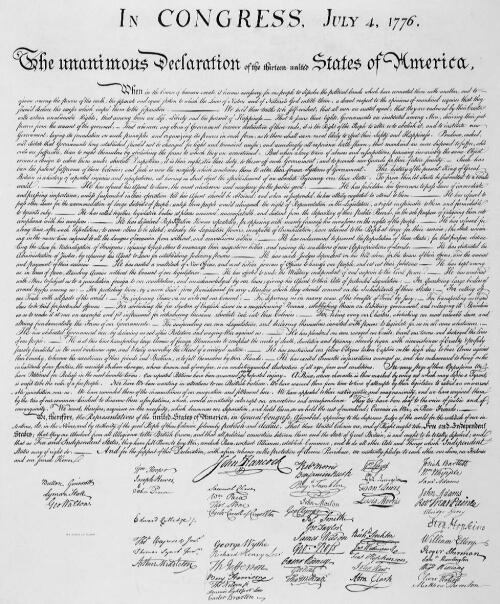
To our country, the Declaration of Independence is the most thorough and important break up letter ever written. Why a break up letter? The Declaration of Independence lists the feelings of the colonialists, and then lists the Crown’s shortcomings…essentially emasculating it. And before you say, “That’s not what happened,” let’s go through the reasons that the Congress decided it was necessary to institute its own government.
First, the Congress declares:
We hold these truths to be self-evident, that all men are created equal, that they are endowed by their Creator with certain unalienable Rights, that among these are Life, Liberty and the pursuit of Happiness. […] But when a long train of abuses and usurpations, pursuing invariably the same Object evinces a design to reduce them under absolute Despotism, it is their right, it is their duty, to throw off such Government, and to provide new Guards for their future security. The Declaration of IndependenceThe colonies felt smothered by the Crown and that it was within their right to break it off, but not before giving a list of the Crown’s inadequacies. The king wouldn’t pass laws, nor would he allow the colonies to pass laws concerning pressing matters. He dissolved legislatures without planning a way for them to be reformed, essentially leaving colonies without government. He allowed his armies to take over the colonies during times of peace and war, and had no manner of controlling his armies. Congress accused the Crown of standing in the way of its happiness. The Congress broke it off after attempting to work out the differences, and the Crown refused to compromise. Not only did it refuse to compromises, but also it added insult to injury.
After the war that sent the ex in to a slow decline of self-pity and a desire of revenge, Congress enacted the Articles of Confederation.
Congress sought a government similar to that of the charters, but allowed for none of the abuses that they suffered with the Crown. It wanted a government that would protect them from foreign powers that saw them as fresh meat and the Native Americans that were furious at them for usurping their land. It also wanted a government that would allow the states their autonomy, as they had under the charters. It wanted a government that would act when it was necessary, but otherwise butt out of their affairs. It obviously didn’t obtain that with the Articles of Confederation, but why? Is it because Congress knew what it didn’t want, but had no idea what it wanted? Is it because it relied on the models of other governments to show them the way? Or, like a college freshman away from home, is it because the greatest minds of the time saw it as an experiment, in which they sought the freedoms they were denied?


