Sunday, October 25, 2009

Treaty of Paris

Where did the war debt come from? I think we need to look to the Treaty of Paris for an explanation.


Once you get past the flowery language and religious references, the treaty was between Great Britain, France, Ireland (what did Ireland have to do with anything?), and the arch-treasurer of the Holy Roman Empire. Peace between the US and Great Britain was conditional upon peace between Great Britain and France. John Adams, Benjamin Franklin, and John Jay were representing the US, with David Hartley, Esq., representing Great Britain.
In the treaty, King George recognizes the states to be sovereign and independent and relinquishes all claims to them. The boundaries are defined to prevent any conflict over them. It allows for fishing rights on banks where both countries are known to fish. The treaty provides that creditors will recover all bona fide debts contracted.

Article 5 of the treaty stipulates that Congress will recommend that the Loyalists recover their property, allowing them to remain in the US for a year for that purpose. Congress would recommend the states’ compliance, and those who bought the Loyalists’ property would be refunded the full value.

Article 6 provides that no one would be prosecuted for participating in the war, and any one who was prosecuted before the treaty would be set free.

Article 7 outlines King George’s obligations. In addition to the peace being “firm and perpetual”, all prisoners on both sides were to be set free. King George was to withdraw his army and navy without destroying or taking any property (including slaves), while leaving any American artillery in the fortifications. The crown was also to return all archives, records, deeds, and papers to their rightful owners.

Great Britain and the US agreed to free and open navigation of the Mississippi River for their citizens, and that any territories conquered after the war but before the treaty to be returned. This treaty was to be carried out within 6 months of its signing in Paris.

George swallowed his pride and accepted a treaty, but the US was screwed. Not only did it have to return property to the Loyalists, which was probably expensive, but it also had to pay off war debts. Didn’t it borrow money from the French? That’s probably why the French were party to the Treaty, and why the Articles of the Confederation provided for the common treasury to pay off all debts accrued. The debts of the US led to a depreciation of the currency, inciting people like Shay to revolt. Revolution and rebellion is the American way, but it doesn’t have to be bloody or forceful. The anonymous author of the editorial called for a peaceful and dispassionate resolution because, in his opinion, it was the best way to come to an agreement. That’s probably how we got to the Annapolis Convention, where our Constitution was conceived.

Before the Annapolis Convention

The Annapolis Convention is where the greats of old negotiated our current constitution.  To figure out why they decided they needed to change their system of government, let’s take a look at some events leading up to it.
Shay’s Rebellion

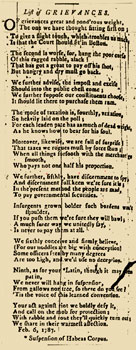
Around 1787, the people of Massachusetts got tired of their current system of government.  What did they have to complain about?  The court was as far away as Boston (I guess they lived out in the country, and nobody had a car), they paid high taxes that didn’t benefit them, the people were starving, and they felt officials were paid too much. 


In an editorial to the government, an anonymous citizen noted:
so the people at large, when they view their present constitution as inadequate to the ends of civil government, have an undoubted power according to the declaration of the bill of rights, to alter or set aside the same, when the period comes, which they, the people, have fixed for that purpose ("To the Public")
No one was satisfied with the current conditions, and by right, they could set aside the current constitution.  The author of the editorial noted their grievances, but cautioned that they should revolt by peaceable means. 

The people wanted to set aside the court of common pleas because it was expensive.  The author explained that the corruption of people that made it expensive, and if they wanted to change the courts, they’d have to change the state’s laws, too, because they were tied together.  The author expressed the fear that if justice courts were set up, it would give magistrates more power, and people would bring frivolous suits to court, clogging up the system, and attorneys
would become more influential and would increase in numbers.

The people wanted a standard currency.  Anonymous explains that the people called for paper money issued by the government because their state’s paper money had lost value because of high internal debt and counterfeiting.

The people were also upset because the government was relatively expensive to run.  The author defended the government’s expenses, explaining that it was true that running the government was expensive, but only a small portion of taxes went towards running the government, the rest went to war debts.

This letter to the public arose at the rise of Shay’s rebellion.  Imagine a bunch of farmer gathering pitchforks and guns to fight against unjust conditions.  The elite and non-elite alike agreed that there was something wrong with governance of the country, but disagreed on how to handle it.  The elite thought a peaceable rebellion was in order; most likely, they advocated writing anonymous letters in the newspaper expressing their discontent.  The non-elite were incited to action after getting fed up, and used whatever tools that were available to them.